Sunday, March 9, 2014

U.S. energy boom proposed as Ukraine bargaining tool.

The article can be found here.

   The U.S. energy boom continues to expand with record-setting natural gas production and petroleum product exports, prompting debate about its use as political leverage over countries like Russia (article). Some members of Congress suggest that we can use our natural gas exports to weaken Russia's hold over Ukraine and the rest of Europe. Energy experts say this time frame and other factors make it highly unlikely that the United States will be able to use its natural gas production to defuse the current crisis in Crimea.

   I think that this is a nice idea, but it's not really possible for us right now. We are just still so reliant on other countries for things like gasoline, we still import a substantial amount of energy. But if this all did work for us, I think that it would be a good idea for us to be an important supplier of goods to these close knit countries. It would give us a strong hold in our foreign policies with them. If only we lived in a world where we all help and receive help with all the other countries. Unfortunately it isn't all that simple, but sometime down the line we will (hopefully) find something that can help us better connect with these seemingly fragile (and potentially dangerous) countries.

Saturday, March 8, 2014

While Britain floods, politicians debate climate change.

The article can be found here.

   This article is about how scientists studying the weather (and more specifically, the floods) in the UK have evidence that suggests there is a link to climate change. The former Conservative party Chancellor Lord Lawson dismissed these comments as “absurd” for drawing a link between the floods and climate change. Others in government disagree. “This type of climate change denying conservatism is willfully ignorant, head in the sand, nimbyist conservatism,” said Ed Davey, the U.K.’s Secretary of State for Energy and Climate Change, in a speech on Feb. 13.

   I think it's a bit silly for those in the government to deny that climate change has anything to do with the floods, but it is also just as silly to blame this one event on climate change. There's not a whole lot that the British government can do about it. They can't fix the floods, but maybe they can implement more preventative measures in areas that are at high risk of flooding? And maybe slowly add more environmentally friendly changes to every day life in Britain (and the rest of the world should do this as well) to help counteract our impact on global warming? Britain can't do too much to stop the extreme weather that is bound to come, but maybe take some preventative measures to ease the impact a bit. We are all responsible for the climate change, so we should all be working to repair some of the damage made.


Russia has already lost the war.

The articles can be found here and here.

   The articles are about Russia's decision to invade Ukraine. Putin obtained permission from his parliament to use military force to protect Russian citizens in Ukraine. What Russia is doing violates the principles of the U.N. charter. Canada, France, Germany, Italy, Japan, the United Kingdom and the United States condemned Russia's "clear violation of the sovereignty and territorial integrity of Ukraine". Putin seems to have genuinely believed that his forces would be warmly welcomed by half of the country.

   What a mess. Putin may believe that what he is doing is best for both Russia and the Russian citizens in Ukraine, but I believe it is the exact opposite. This choice will very negatively impact Russia's standing in the international community and it could also isolate them economically. Aside from consequences that directly impact Russia, this could be a bad turn for the entire world. Since it's too late to stop Russia from intervening, the next best thing would be for Russia to honor its international commitments, to send it military forces back to Russian bases, and to refrain from any further interference in Ukraine. 

Monday, February 24, 2014

Marijuana in Mexico City.

The article can be found here.

   The Mexico City government is considering legalizing the sale of marijuana in the capital, allowing shops to sell the drug in amounts up to 5 grams. Mexico City has already legalized gay marriage and abortion. This bill has the possibility of creating an island of legalization of one drug in a nation that has been devastated by the fallout from the US-backed fight to stop the northbound flow of recreational narcotics. If it is approved, the Mexico City legislature could find itself at odds with federal government.

   I think that it may be in the best interest of the Mexican government to legalize marijuana throughout the entire country. Putting an end to the taboo surrounding this mild drug would give the Mexican police a chance to focus in on slowing the spread of harder drugs and the violence that goes along with it in Mexico. It would also ease the traffic in prisons so that they can more efficiently detain violent criminals rather than just a whole bunch of pot-heads. This could also bring in money for the entire country. Just like in Colorado, putting a tax on the product would really benefit the country as a whole. All in all, I think that though it would be a big step, it very well may be a step in a better direction.

Friday, January 31, 2014

Bird flu resurge in China.

The articles can be found here and here.

   There has been outbreak of H7N9 bird flu just in time for the Lunar New Year - peak time for travel, poultry sales, and mass contamination. In January alone, 19 deaths and 96 human cases have been reported, according to figures from the Chinese Center for Disease Control. According to the WHO, most of the human cases were exposed to the H7N9 virus through contact with poultry or contaminated environments, such as live bird markets.

   This could spread, not only to neighboring countries, but all around the world as well. Through the increasing impacts of globalization, many countries, as well as the United States, have frequent contact to China, through trade especially. If  we, as well as China, aren't careful, this could easily become a worldwide epidemic. It is quite bad luck that this outbreak has come at such an inopportune time. It will be very hard to suppress the spread of H7N9 during the celebrations of the Lunar New Year. Hopefully China's government takes some precautionary steps in their distribution of poultry and travel. Like all flu viruses, this will fade during May but will probably return next year. Salud (it's Spanish, culture yourself :). 

Homophobia in Nigeria.

The articles can be found here and here.

   Nigeria has passed a ban on same-sex marriage, introducing a wide range of offences which are in violation of fundamental human rights. They include 14-year jail terms for same-sex couples who live together or attempt to celebrate their union with a ceremony. Police in northern Nigeria have arrested individuals believed to be homosexual and have even tortured them. Another law could prevent those who are LGBT in Nigeria access to HIV services.

   Here in the United States we've seen a lot of fear and opposition to the LGBT+ community, but even though our nation doesn't wholeheartedly agree with the idea of complete equality, thankfully we are loosening our belt rather than tightening it, like in Nigeria. The hate and discrimination that these people face, it is truly sickening. Not only does it endanger those in the LGBT+ community, it also puts supporters, organizations, and activities that have any relation to said community in danger. The laws will most certainly lead to increased homophobia, discrimination, denial of HIV services and violence based on real or perceived sexual orientation and gender identity. These laws also come in the way of the effective responses to HIV/AIDS in the country. Not only does this have negative effects on the LGBT+ community, but it will largely impact the entire Nigerian country.


Tuesday, January 21, 2014

After Iran confirms it has halted certain nuclear activity, U.S. and EU loosen spigot.

The article can be found here.

   Iran, agreeing to a deal between the United States and the European Union, on Monday announced that it has ceased certain nuclear activities that it agreed to halt as part of its breakthrough deal with western powers. The November deal called for Iran to cease enrichment of uranium above 5%, begin the process of diluting some of its stockpile of 20% enriched uranium, and verify that it has not installed additional centrifuges at two key nuclear facilities.As part of the deal, Iran will gain access, in installments, to roughly $4.2 billion of its restricted reserve funds over the next six months. The funds will be dispersed as Iran makes progress in completing its dilution of 20% enriched uranium. Another $2 billion will come as a result of loosening some trade restrictions in the petrochemical, precious metals and auto industries. Iran is also expected to receive some relief that will allow it to make payments for humanitarian goods, university tuition assistance for Iranian students abroad and Iran's U.N. obligations (article).

   This is a great and scary thing. The benefits and goods from this deal will help Iran to (hopefully) grow more stable and (another hopefully) better improve conditions within the country. This is a benefit of globalization (as discussed in class today), services and information can easily be shared from all over the world. But a detrimental cost to this deal is that as Iran's economy continues to improve, the Iranian leadership will have less incentive to negotiate a comprehensive nuclear deal. Our leverage on Iran is shrinking, and this could be dangerous. But the Obama administration counters that the overwhelming majority of more than a decade of sanctions against Iran's oil, banking and financial industries remain in place and the U.S. remains committed to aggressively enforcing the existing sanctions. I'm hopeful that Iran takes this as an opportunity to improve itself and becomes an ally with the United States through trade and various other sources. (I apologize, I don't fully understand what I'm doing on these comparative blogs yet.)

Sunday, January 5, 2014

Legal pot sales began Jan. 1 in Colorado.

The article can be found here.

   This article is about Colorado's experiment with being the first state to legalize recreational marijuana (19 states and Washington, D.C., allow medical marijuana). Recreational pot will also go on sale mid-2014 in Washington. One of the biggest questions is whether they have built an industry that will not only draw in tens of millions of dollars in revenue but also make a significant dent in the illegal market. All eyes will be on Colorado over the next 24 to 48 months.

  I think this experiment has a lot of potential. Legalizing cannabis is the first step in denting the subculture of harder illegal drugs. Not only will this experiment rack in money by the ounce, but it will provide a way for regular people to use and avoid having to deal with sketchy drug dealers. I think Colorado's new law will promote education on the subject of psychotropics and encourage people to become educated about cannabis. No plant has faced more public misconceptions than cannabis. It is both safe and beneficial not only to medical patients searching an escape from chronic physical and emotional pain caused by AIDS, Cancer, Depression and many other illnesses but will also give people a chance to explore their own consciousness with peace of mind and a joint in their hand.

Are there enough doctors for newly insured?

The article can be found here.

   This article talks about how thousands of Americans gained coverage on January 1st but many live in areas with too few primary care doctors and many of those doctors and dentists do not accept Medicaid patients. A big contributor to these shortages are the aging baby boomers. The growing medical needs of that large age group are creating a huge burden for the existing health care workforce and the retiring of many doctors from the baby boomer generation add to the problem. Another contributor is that medical students now value a "work-life" balance. And men and women alike are looking for careers that are compatible with part-time hours so that they can be more engaged in child care. Additionally, all the negative attention on medicine in general has made it a far less attractive career choice than it once was. But despite the shortages, many believe that new technologies will extend the reach of medicine in ways that will help the problem.

   To start, with the passing of the ACA I think that these doctors and dentists should be required by law to accept Medicaid patients. Primary care is a basic need and Medicaid should be enough of a qualification to receive that. I think that the introduction of new technologies can definitely help with this shortage of doctors. New technologies introduce new specialties to the medical field, more chance of successful procedures, and more incentive to pursue a medical career. These next few years may still be rough, but I think that now there is a higher demand for doctors, it will become an appealing career path again and things will take an upward turn soon enough.

Health law may not broaden access to mental treatment.

The article can be found here.

   This article talks about how the ACA requires insurers to cover mental health care just as they do with physical health care, but only half of psychiatrists accept health insurance. That means that many of the people seeking treatment for their mental health problems are having to pay for it entirely out of their pockets, and according to the National Institute of Mental Health, about one of five adult Americans, or about 58 million people, suffer from a diagnosable mental illness in a given year. Jamison Monroe of Newport Academy, a mental health and addiction facility for people ages 12 to 20 in Connecticut and California, said "Sole practitioners don't have any recourse. That's why they only take cash". But it is said that this problem may spark a better understanding of mental health and help break down the stigma for brain-chemistry diseases such as depression, schizophrenia, or PTSD.

   The issue of mental health is definitely growing in awareness and it is important that these people who seek help and treatment are able to afford it. Mental health care is just as important as physical health care and we need to solve this void in the system so that we can insure them equally. It's great that the ACA requires insurers to cover mental health care, we are definitely on the right track. Now we (with the help of our federal government) need to come up with a system that will successfully enable all psychiatrists to accept health insurance. There isn't really a good solution yet with so many factors to take into account. But it should certainly be added to the list of things that need improvement. Hopefully our federal government takes a good look into this issue sooner than later.

Tipped workers often face different minimum wages.

The article can be found here.

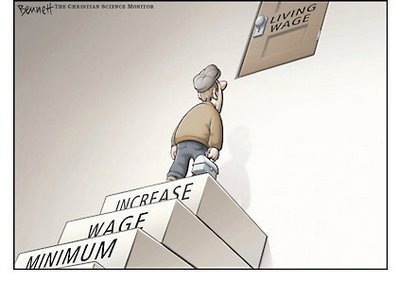
   This article is about how tipped workers are struggling to make minimum wage and their federal minimum wage hasn't increased since 1991. The idea is that (as we all know) the tips they make on top of their low minimum wage (often ranging between 4 and 5 dollars) are supposed to bring their pay up to the minimum wage that everyone else is entitled to. The amount they will make in tips is unpredictable and there are some restaurant owners who will take portions of the tips. It also talks about low-wage advocates, some of the states raising their minimum wage, and how the Senate Democrats would like to raise the minimum wage to $10.10 in 2014.

   These low-wage workers definitely deserve a raise in their minimum wage. Ideally, I think that their minimum wage should be the same as ours and tips should be a reward on top of that. Often times, many of us do not realize how important fair tips are for these people. Maybe a good solution to this ignorance on our part is to add the price of the tip to the service we are seeking. So that way, rather than separating the two prices, they are combined and standard so that it isn't up to us to calculate (because we Americans are quite lazy...) and these people aren't relying solely on the customer's "generosity" to give them a reasonable tip. I think that the federal government raising the minimum wage is definitely a good step in the right direction.  And maybe years down the road it won't be a separation between "low-wage worker's minimum wage" and "state minimum wage", it'll all be one set minimum wage (preferably at a livable wage).